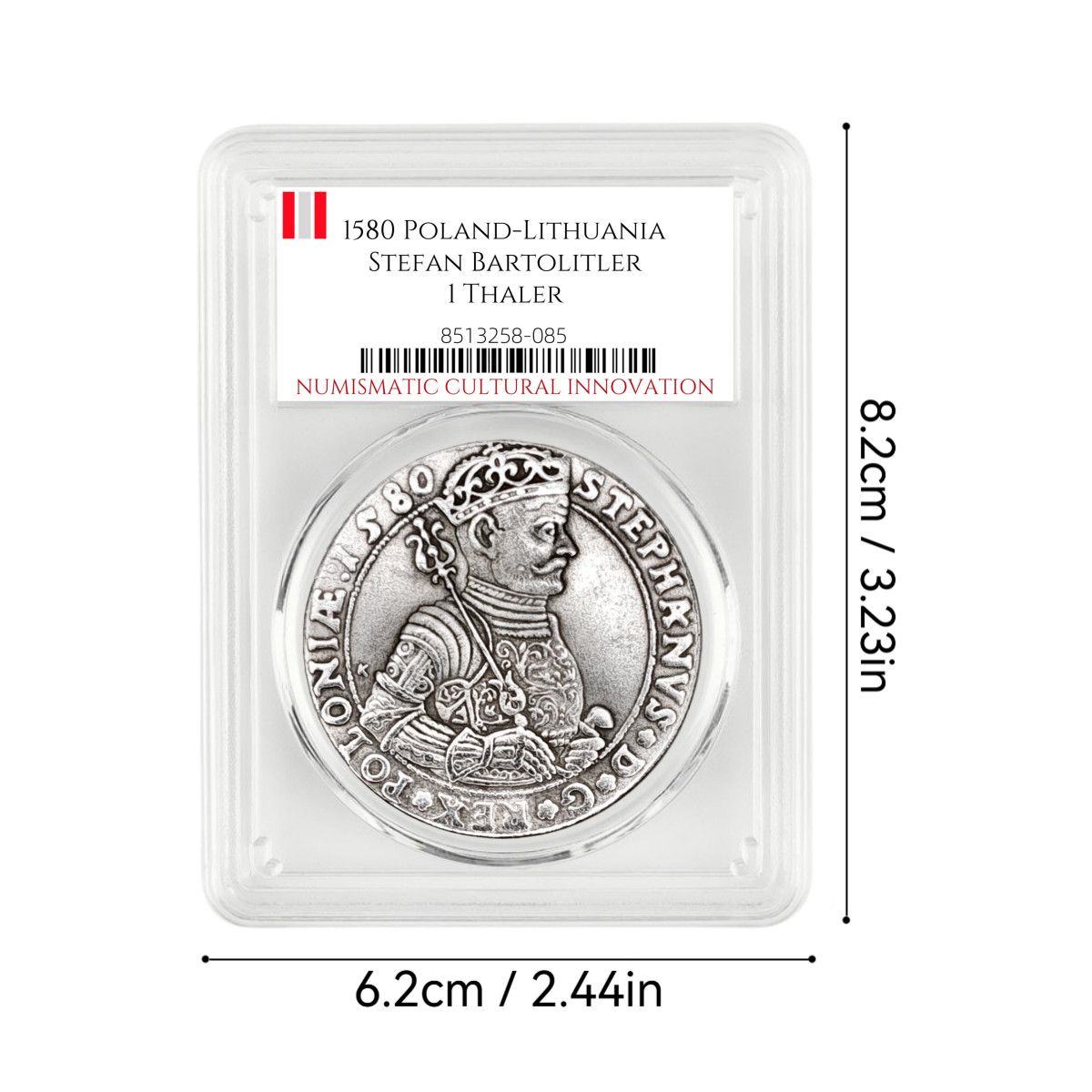
1580 Poland-Lithuania Stefan Bartolitler I Thaler
1580 Poland-Lithuania Stefan Bartolitler I Thaler
Couldn't load pickup availability
Product Overview
This 1580 Thaler coin was issued during the reign of King Stefan Batory (Stefan Batory / Stephen Báthory), ruler of the Polish–Lithuanian Commonwealth. It is a historic silver coin representing one of the most powerful and influential monarchs of 16th-century Eastern Europe.
Historical Background
Stefan Batory ruled the Polish–Lithuanian Commonwealth from 1576 to 1586. He is widely regarded as a strong military leader and reformer who strengthened the state and modernized its army. Coins from his reign reflect the political stability and growing influence of the Commonwealth during the late Renaissance period.
This 1580 Thaler belongs to an important era when large silver coins were used for international trade across Europe.
Design Features
The obverse typically features a royal portrait of Stefan Batory with Latin inscriptions emphasizing his royal title and authority.
The reverse often displays heraldic symbols of the Polish–Lithuanian Commonwealth, including the crowned eagle of Poland and the Pahonia (Vytis) representing Lithuania, symbolizing the dual state structure.
Collectible Value
Coins from Stefan Batory’s reign are highly sought after due to their age, historical importance, and relatively limited survival rate. As an early European Thaler, it is an important piece in the development of modern coinage systems and is valued by collectors of Renaissance and early modern European history.
Key Features
- · Dated to 1580 under King Stefan Batory
- · Polish–Lithuanian Commonwealth silver Thaler
- · Strong Renaissance-era European history connection
- · Features royal portrait and dual-state heraldry
- · Highly collectible early European large silver coin
Ideal For
- · Ancient and early European coin collectors
- · Polish–Lithuanian Commonwealth history enthusiasts
- · Renaissance-era artifact collectors
- · World silver Thaler collectors
Condition Note
As a coin from the 16th century, significant variations in strike, wear, toning, and surface texture are expected. Each surviving piece carries unique historical character shaped by centuries of history.