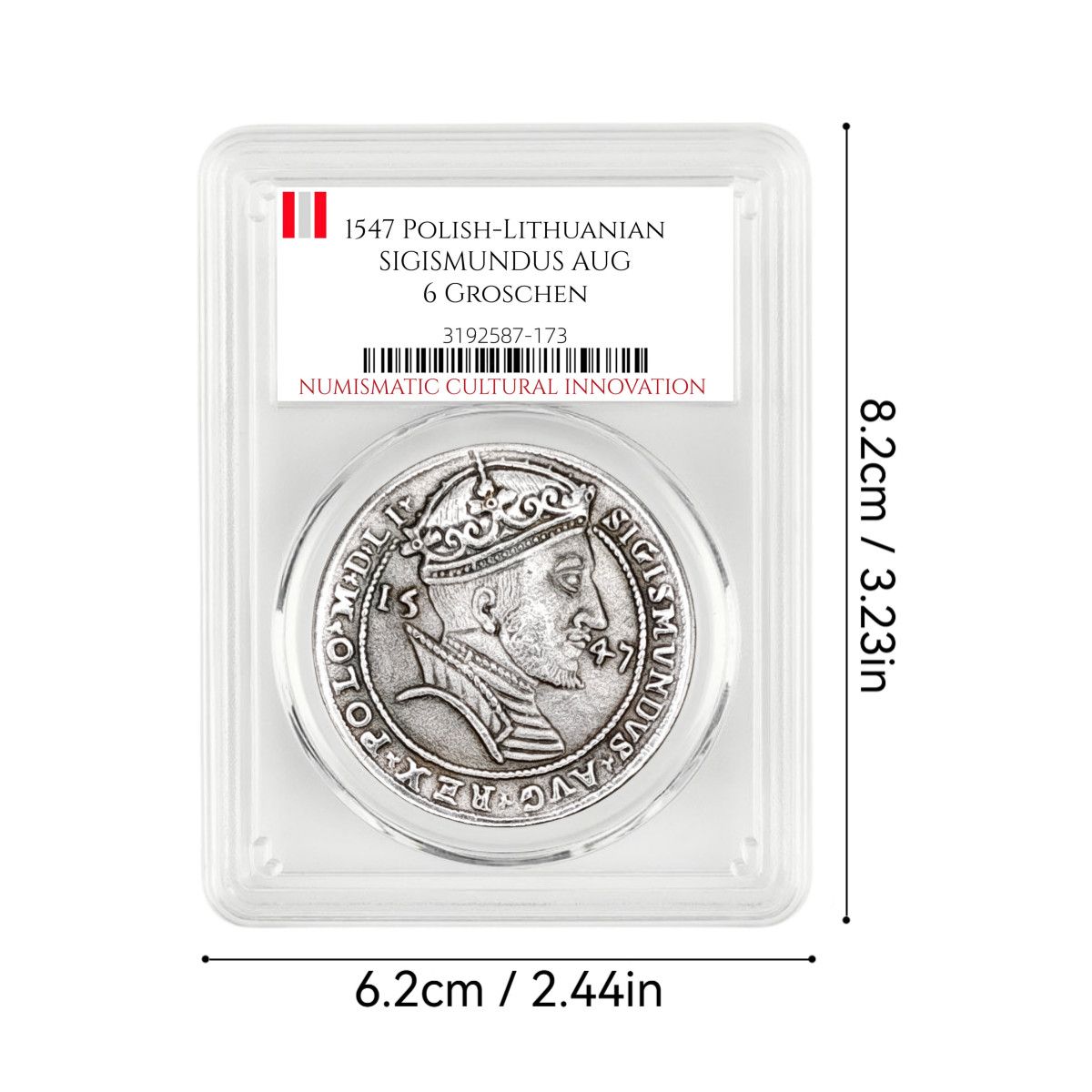
1547 Polish-Lithuanian Sigismundus Aug 6 Groschen
1547 Polish-Lithuanian Sigismundus Aug 6 Groschen
Couldn't load pickup availability
Product Overview
This 1547 6 Groschen coin was issued during the late reign of King Sigismund I the Old and the early influence of Sigismund II Augustus in the Polish–Lithuanian Commonwealth. It is an important Renaissance-era silver coin representing one of the most powerful monarchies in 16th-century Europe.
Historical Background
The Polish–Lithuanian Commonwealth during the mid-1500s was a major political and economic power in Europe. Sigismund I the Old (Zygmunt I Stary) and his successor Sigismund II Augustus played key roles in strengthening the state, modernizing administration, and expanding trade networks.
Coins from this transitional period reflect the growing stability of the Commonwealth and its increasing importance in European commerce and silver-based monetary systems.
Design Features
The obverse typically features a royal portrait or crowned monogram of the ruling king, along with Latin inscriptions such as “SIGISMVNDVS” or “REX.”
The reverse commonly displays the Polish Eagle and Lithuanian Pahonia (Vytis), symbolizing the dual structure of the Commonwealth, along with denomination markings “VI” (6 groschen).
The design reflects classic Renaissance engraving style with strong symbolic and heraldic elements.
Collectible Value
This 6 Groschen coin is highly sought after by collectors of early European silver coinage. Its age, historical context, and connection to the powerful Jagiellonian/Vasa transition era make it an important numismatic piece. Surviving examples are valued for their rarity and historical significance.
Key Features
- · Dated mid-16th century (1547)
- · Polish–Lithuanian Commonwealth silver 6 Groschen
- · Associated with Sigismund I / Sigismund II era transition
- · Features Polish Eagle and Lithuanian Pahonia
- · Strong Renaissance European historical value
Ideal For
- · Early European coin collectors
- · Polish–Lithuanian Commonwealth enthusiasts
- · Renaissance silver coin collectors
- · Historical numismatics researchers
Condition Note
As a nearly 500-year-old silver coin, natural wear, weak strikes, edge irregularities, and patina are expected. These features are normal and reflect its authentic historical journey.